
Without a documented voice, even your best writer is just Claude with a day rate.
That’s not a talent failure. It’s what happens when your brand voice is a “vibe” and the brief is a website and a prayer.
You’ve already caught it.
The freelancer’s draft that was competent, technically clean, nothing actually wrong with it, but kinda flat.
The ad that sounded like it came from a different company than your product page. An email went out while you were traveling. You caught it three days later, and although it was fine, it wasn’t “you.”
/ it’s fine. it’s just not us.
And so you rewrote it, not because you had time to, but because you couldn’t let it go out the way it was.
If you’re like most brand founders, you’ve done some version of this:
- Sent a writer your website and three old emails and called it a “brand brief”
- Approved copy you were 70% happy with because fixing it yourself would take longer than writing it from scratch
- Watched an agency nail it for the first two months, then slowly drift into sounding like everyone else in your category
- Walked a new writer through the brand voice… again
- Read a product page, an email, and an ad from your own brand and realized they don’t sound like they came from the same company
Truthfully, none of this is the writer’s fault.
It’s what happens when voice lives in one person’s head and nowhere else.
Here’s why voice drift keeps happening.
Every freelancer, agency, and in-house hire who writes for your brand is working without a foundation.
They’re interpreting your brand from whatever they can find. The homepage… a few archived emails… the brand deck from two years ago with your color palette and three adjectives.
Everyone who touches it makes a different call. None of the calls match.
This isn’t a talent problem. You haven’t just hired a streak of bad writers. It’s a structural problem: you’re handing off a function nobody has written down. That doesn’t fix the bottleneck. It just relocates it.
Finding a better writer who somehow intuits what you mean won’t solve it. You need the foundation that makes any writer capable of sounding like you.
The Brand Voice OS
A done-for-you brand voice system extracted directly from the founder, built into a working document, and structured so any writer, agency, or in-house hire can produce copy that sounds like your brand.
On any channel.
- emails
- product pages
- landing pages
- paid ads
- SMS
- social
- everywhere else your brand uses words
One documented system. Consistent output regardless of who’s writing it.
What you walk away with
- The master brand voice guideThe document a writer opens before writing the first word. It defines how your brand sounds: the tone, the vocabulary, the phrases you own and the ones you never use. It’s something you can hand to any writer and trust they’ll come back with something that “sounds right.”
- Channel voice sheetsOne for email. One for product pages. One for ads. Each channel operator gets a focused quick-reference pulled from the master guide without needing to read the whole thing every time they sit down to write.
- The voice flex matrixThink of this as the calibration layer. Your brand shouldn’t sound the same to a first-time buyer and a three-year loyalist. The matrix shows how the voice modulates across audiences and contexts without losing what makes it recognizable. This is what holds consistency together as the team grows and new people come in.
- Onboarding walkthroughA recorded orientation so whoever you bring in next gets up to speed without the founder explaining it from scratch. Set it up once, then every new hire, agency, or partner uses it from day one.
- The pre-send checklistA fast, usable checklist for every piece of copy before it leaves the brand. Any writer or editor can run it in five minutes. The best part? The founder stops being the last line of defense.
- AI prompt scaffoldingFor brands using AI tools in their content workflow (we see you): the voice is already in the prompt. AI-assisted copy will sound like your brand because the system travels into the tool. When production scales, your voice doesn’t have to be diluted.
Who builds it
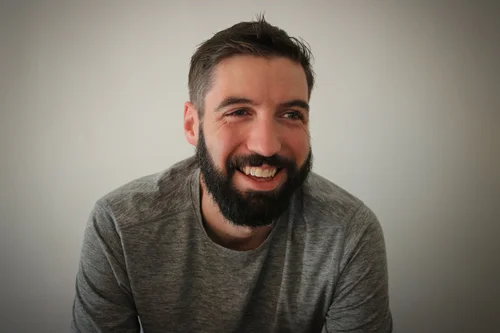
Real People is Matt Snyder. Nearly twenty years in conversion copy, most recently building brand voice systems and copy QA frameworks across a DTC portfolio before founding this studio.
At his last agency, he led the copy department as it grew from two writers to ten. That experience shapes the work here: making client feedback usable, helping new writers get oriented, and giving everyone a shared reference across channels.
Your system is built from your brand’s actual language and decisions, with guidance your team can use on the next assignment. Every deliverable is human-written and human-approved (that’s a craft stance, not a policy). AI replicates what’s already been written. Your brand voice is what hasn’t been.
Real People carries a deliberately limited client roster. Every brand in the portfolio gets a partner who actually knows the brand: the seasonal calendar, what the customer actually responds to, the specific phrasing that makes the voice work. Not a handler who manages the relationship while a junior-level team member does the writing.
Depth is the product.
What 30 days actually looks like
Most of the work happens on our side. Here’s what happens on yours.
You talk. You write. We listen.
Two focused conversations with Matt. One to extract the voice. One to review and align on the system. And a few targeted worksheets. That’s the founder’s full-time commitment.
We build.
We handle the research, writing, and structure. We pull from the founder’s own words, the brand’s best-performing copy, and what your actual customers say in reviews and support tickets. The founder doesn’t run a single task in this phase.
You review.
A check that what’s in the document matches what you hear in your head. If something’s off, we fix it. Most clients need fewer changes than they expect.
You deploy.
Delivered in 30 days. Shared with every team member, agency, and channel partner from that day forward. The foundation every future piece of copy gets built on.
A few things founders ask before moving forward
What if we already have brand guidelines?
Brand guidelines and a brand voice system are different documents. Most brand guides define visual identity: colors, fonts, logo rules. Even those that touch tone of voice typically offer adjectives without the calibration layer, vocabulary reference, or channel-specific guidance that makes a voice executable.
A brand guide tells a writer your brand is “direct and human.” The Brand Voice OS tells them what direct and human sounds like on a product page versus a win-back email versus a cold ad. Those are different problems and this system handles each one.
I don’t have time to take on another project.
Two calls. That’s it. Everything else happens on our side. Done-for-you, not done-with-you. You don’t clear your calendar to make this happen.
How do I know you’ll actually capture our voice?
The extraction process starts with the founder’s own words, the brand’s best work, and the language your actual customers use: reviews, support tickets, the phrases real buyers reach for.
Because the roster is limited, there’s no account hand-off after the intake call. The person on those two conversations is the person building the system (Matt… Matt is that person).
What if we’re already working with an agency or freelancers?
The Brand Voice OS is built so any external partner can use it. Most clients find it cuts revision cycles significantly because writers are no longer guessing at what “on-brand” means. Hand the system to your agency or freelance partners on day one. That’s the point of it.
What happens after the system is delivered?
The OS is a standalone deliverable. Some clients use it as the foundation for an ongoing retainer with Real People, where we help with other aspects of your acquisition and retention programs. Others deploy it with their existing team or agency partners. Either way, the goal is the same: your brand has the system it needs to run without depending on any one person.
The Brand Voice OS has limited availability.
If revision cycles are eating your time, if copy keeps going out that doesn’t sound like you, if you’re still the one catching every mistake before it leaves the brand, this is the work that fixes the structure underneath all of it.